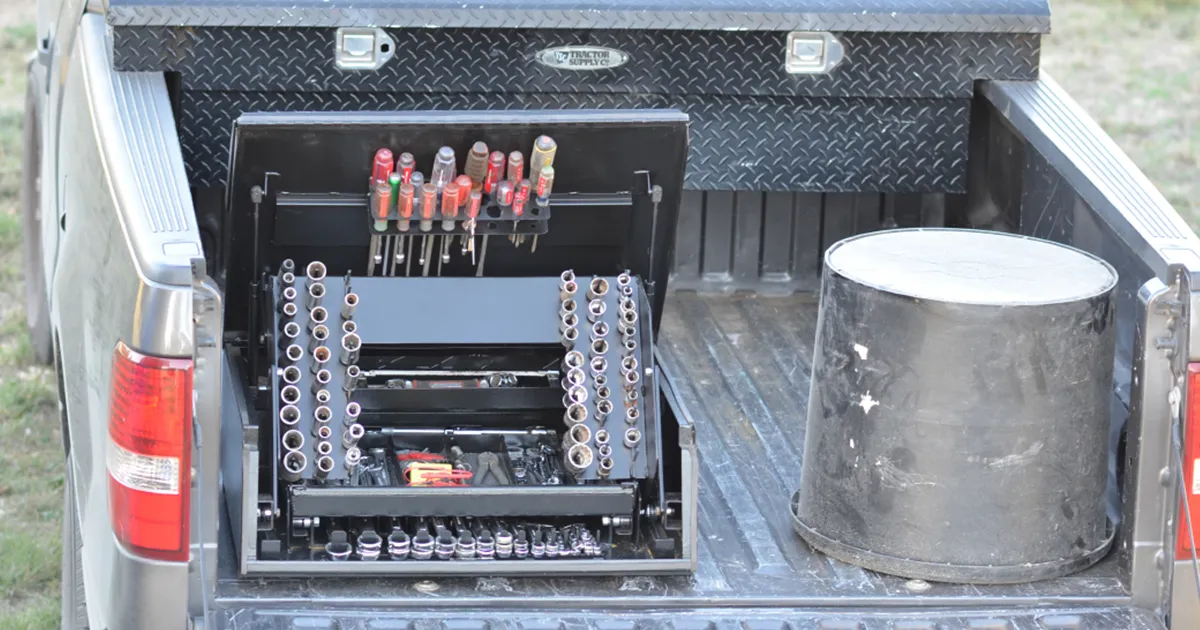
If you carry tools regularly, your truck becomes a mobile shop. The question is whether your current setup protects your tools and your time, or whether it creates daily friction. This guide breaks down the clear signs you need a truck-mounted toolbox, what it fixes, and how to choose a setup that creates a repeatable layout instead of another messy container.
- Who this helps: trades, service trucks, DIYers, small business owners, fleet buyers
- What you will know: the signs you need a toolbox and what to prioritize when choosing one
- What to do next: request a quote for a configuration built around your tools and truck
What are the signs you need a truck-mounted toolbox?
If tools are in your cab, getting damaged, going missing, or wasting your time, you need dedicated storage with a repeatable layout.
Most people wait too long because they get used to the chaos. The signs are simple:
- Tools live on the passenger seat or floorboards
- You avoid carrying passengers because of tool clutter
- Tools roll around and get damaged in the bed
- You buy duplicates because you cannot find what you already own
- You waste time digging for basic tools on jobs
A toolbox is not just storage - it is a workflow system that reduces daily friction.
How does a truck-mounted toolbox help preserve your truck?
It keeps tools from rolling, shifting, and damaging your interior and bed during daily driving.
Loose tools are hard on trucks. They scrape floors, tear upholstery, dent bed floors, and create noise and distraction. A mounted toolbox gives tools a protected home so they stop turning the truck into a damage zone.
If you also want to protect the bed surface, this pairs well with 3 ways to maintain your truck bed.
How does a toolbox help you conserve space?
It moves tools out of the cab and into a dedicated storage zone, keeping your interior usable for people and clean work gear.
A truck can serve both work and life, but not when the cab is packed with tools. A mounted toolbox keeps your interior clear and your essentials contained. You get back usable space without constantly loading and unloading.
For buyers who use a standard pickup bed and want an organized system, see the Fleetside Box.
How does a toolbox protect tools from damage?
It reduces exposure to weather, keeps tools from bouncing and colliding, and supports organization that prevents breakage and loss.
Tools fail early when they live loose in the bed. Water and dust exposure can lead to rust and corrosion, and constant vibration causes wear on cases, meters, and power tools.
A better setup does three things:
- Protects tools from weather and impact
- Keeps tool categories separated so they do not collide
- Supports a repeatable layout so tools do not migrate and disappear
Shop-N-Box systems use a patented roller system on roll-out models to support daily use and fast access. Learn more on how the patented roller system works.
How does a toolbox reduce theft risk?
A mounted, lockable storage setup reduces easy access and helps keep tools out of sight and harder to grab.
If tools are in an open bed, theft is simple. A thief does not need a plan - they just need an opportunity. A mounted toolbox reduces that risk by keeping tools contained and less visible.
No system eliminates risk completely, but secure storage is a strong step. If you are transporting gear on commercial vehicles, FMCSA cargo securement resources are also useful for thinking about safe transport practices. (https://www.fmcsa.dot.gov/regulations/cargo-securement)
How does a toolbox help you stay organized day to day?
Organization saves time because you can grab tools fast and notice missing items immediately.
Time is money on a jobsite. If you spend five minutes hunting for a tool multiple times a day, you are donating labor to chaos.
A toolbox layout that works includes:
- A home for every daily tool
- Clear separation between daily tools and occasional tools
- Visible organization that makes missing tools obvious
- A setup you can repeat without thinking
If you want the simplest explanation of why this matters, read why organization matters.
How do you choose the right Shop-N-Box toolbox setup?
Choose based on mounting space, access needs, and whether you want roll-out access or an opening-style toolbox like the JP Elite models.
Start with your truck and your workflow. Then match the box to how you need to access tools.
Good starting points:
- 2-80 toolbox for two roll-out compartments
- 1-80 series toolbox for one roll-out compartment
- 65 A/B toolboxes for compact setups
- 2-65 A/B configuration for a mid-size dual toolbox setup
- Fleetside Box for pickup bed systems
Note: JP Elite 40 and JP Elite Super 40 are not roll-out systems - they open and unfold to reveal tools:
If you want a quote that matches your tool list and daily use, start here: request a quote.
Related resources
On Shop-N-Box
- Request a quote
- How the patented roller system works
- Why organization matters
- Tips for keeping your truck bed organized
- Fleetside Box for pickup beds
- 2-80 toolbox
External